History
The family tree of music visualizers
Who built the first music visualizer, and what became of it? A sourced family tree, from Atari's 1977 box and Winamp's MilkDrop to iTunes and stem-reactive AI.
Key facts
- What this page is: a sourced history of music visualizers, organized by branch and told through the people who made them. It is not a ranking or a software guide. For current tools, see Desktop and player visualizers.
- Oldest root we cover: Louis-Bertrand Castel's proposed "ocular harpsichord" of 1725†. First consumer box that turned stereo audio into pictures: Atari Video Music, patent filed 23 Aug 1976, sold from 1977.
- Biggest correction to a common story: Apple's own iTunes 2 and iTunes 8 announcements never name who made the visualizer. The G-Force credit comes from SoundSpectrum and a contemporary review, and the Magnetosphere credit comes from its creators. See the iTunes section.
Checked on .
Who built the first one, who copied whom, and which stories turn out to be only half-sourced.
This site is called audio-visualiser.com, with an “s”, but most of the sources below spell it with a “z”, so that’s the spelling we use from here on. The same swirling, melting picture shows up in a 1994 console add-on, a 1998 Windows plug-in and a 2022 AI notebook. Nobody claims these descend from one another. Several people reached the same trick on their own, and then later tools kept rebuilding the older ones. This page follows both: the lines that are documented, and the ones that only look like lines.
Key facts
- What this page is: a sourced history of music visualizers, organized by branch and told through the people who made them. It is not a ranking or a software guide. For current tools, see Desktop and player visualizers.
- Read on: 18 Nov 2026. Every claim below links to a page we opened, with exceptions marked † (we only saw the source in a search summary and will re-open it before publishing).
- How lines are drawn: a line between two tools means we found a source that says one led to the other (a creator’s own words, shared code, or a shared author). Where the only source is a secondary writer, the text says so. Where we found nothing, there is no line, and the text says “unknown”.
- Oldest root we cover: Louis-Bertrand Castel’s proposed “ocular harpsichord” of 1725†. First consumer box that turned stereo audio into pictures: Atari Video Music, patent filed 23 Aug 1976, sold from 1977.
- Most-forked idea: “feed the last frame back into the next one”, from Jeff Minter’s 1994 Jaguar CD light synth to Ryan Geiss’s 1998 plug-in to MilkDrop’s many descendants.
- Biggest correction to a common story: Apple’s own iTunes 2 and iTunes 8 announcements never name who made the visualizer. The G-Force credit comes from SoundSpectrum and a contemporary review, and the Magnetosphere credit comes from its creators. See the iTunes section.
- Biggest unknowns: who made the Windows Media Player visualizations, who drew the first YouTube “spectrum over artwork” look, who is behind HYPERFLUX and Vizzy, and which separation model most stem-reactive tools use.
- Evidence grades used in our data: A1 (creator or company says so), A2 (shared or forked code), A3 (same author), B (reputable secondary source), C (weak: forum, Reddit, SEO blog, app-store page).
- What this page makes no claim about: whether any tool is “better”, who sold the most, or the exact market for any tool.
1. The box Sears didn’t want
The first mass-produced visualizer was a hi-fi component. Atari’s engineer Robert J. Brown filed the patent on 23 August 1976 for a device that turned stereo audio into shapes on a TV (US Patent 4,081,829). Atari sold it from 1977 as the Video Music, model C-240. Atari’s own project name was “Project Mood” (atarivideomusic.net, inventor page).
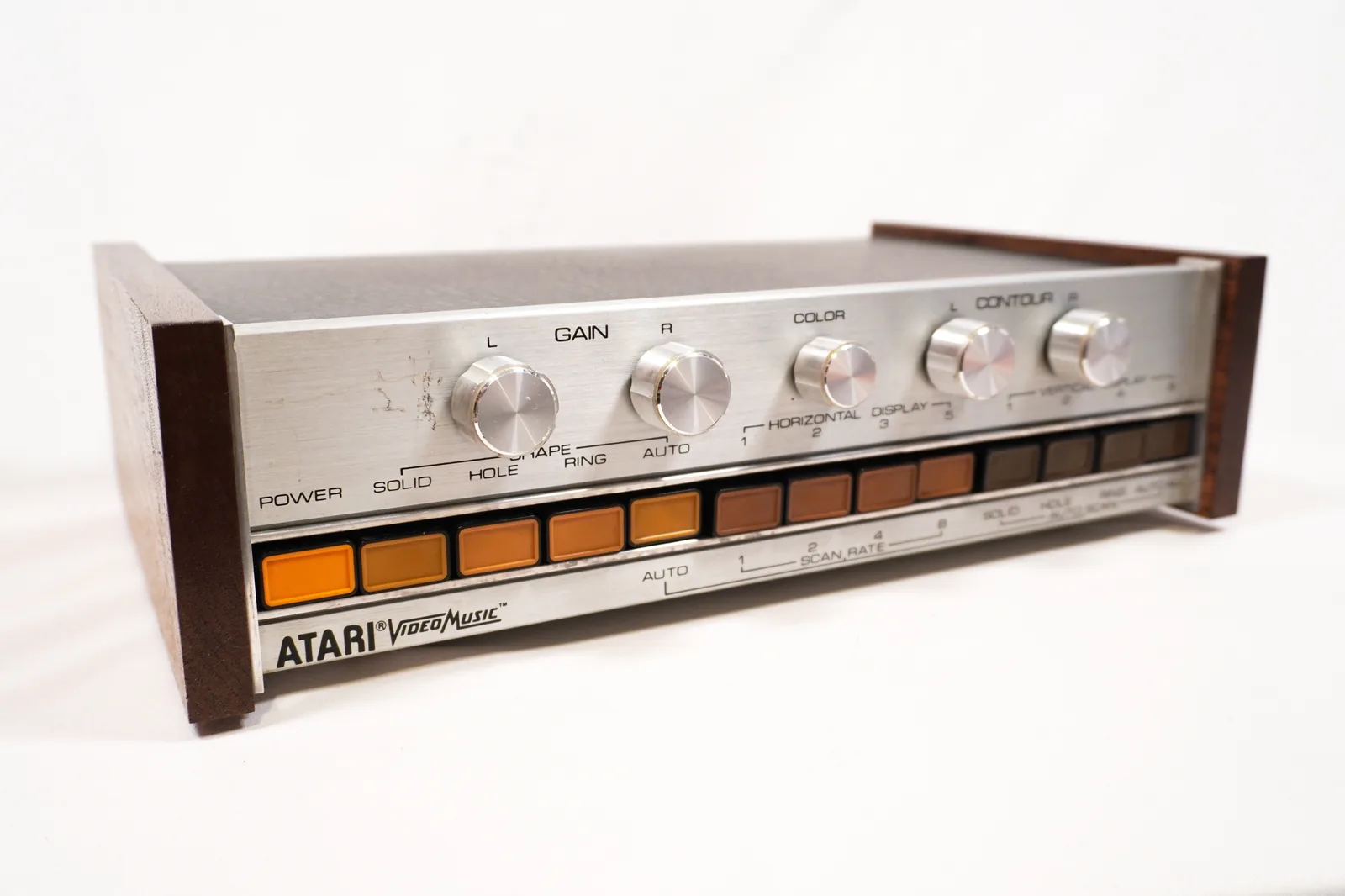
The fan-run history site atarivideomusic.net tells the rest. Sears turned it down. Atari then pitched it for “disco application” on projection TVs, and the product was dropped after about a year (history). The site’s estimate is that between 1,000 and 2,000 were built. Atari engineer Al Alcorn’s factory-sealed unit stayed in its box for 45 years and was auctioned in 2022 (RR Auction lot).
It’s a good starting point because it was the first consumer attempt, but it was not the first idea. Wherever we found no source saying the Atari team copied anyone, we’ve left the line off. They were working in a long tradition.
The tradition it joined
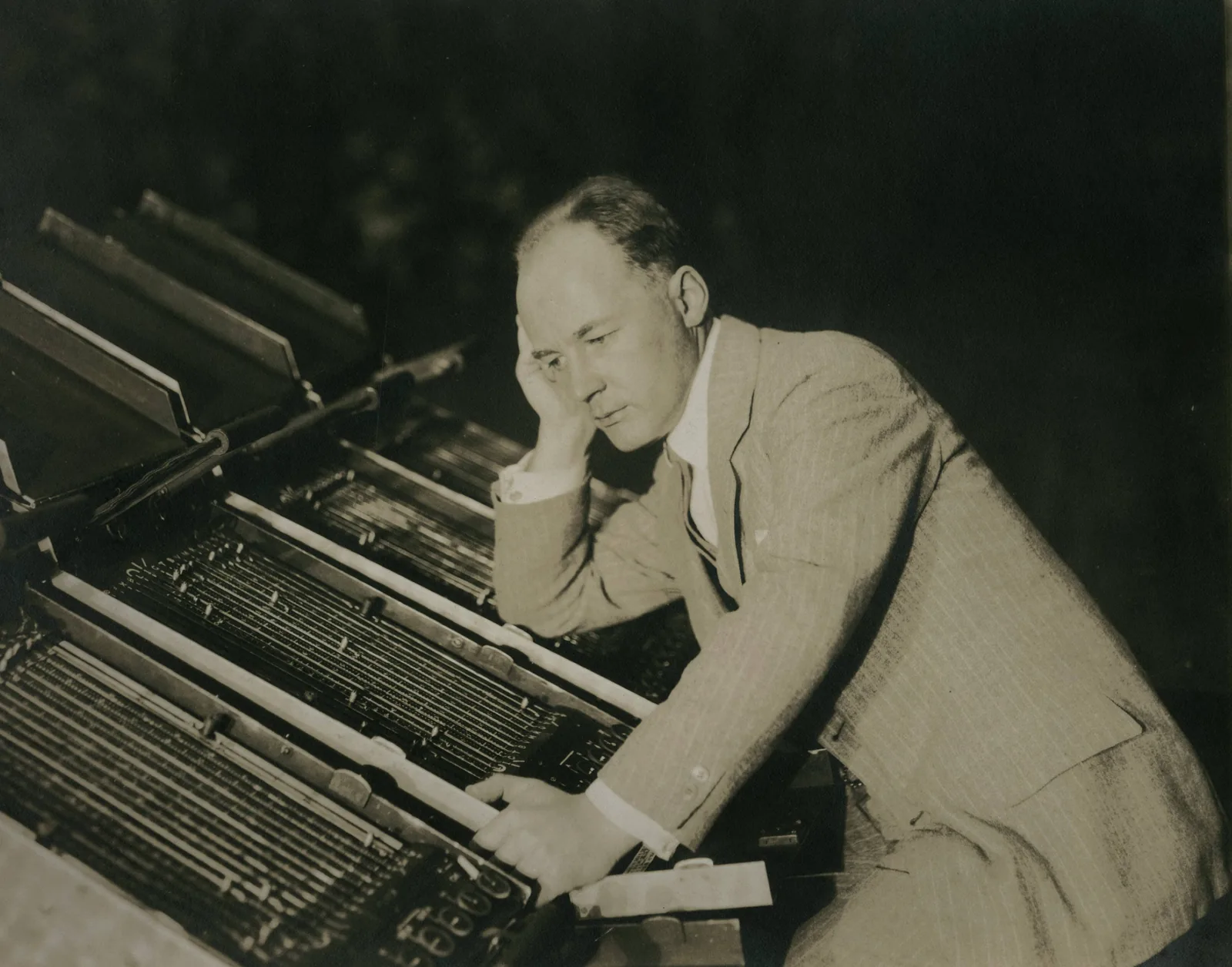
- People played light like an instrument. Castel proposed an “ocular harpsichord” in 1725†, and Alexander Wallace Rimington patented a Colour-Organ in 1893†. Thomas Wilfred’s Clavilux gave its first public recital in 1922 at the Neighborhood Playhouse in New York (Wikipedia). The same source says Wilfred was “passionate that lumia should be a silent art”. That’s the opposite of a visualizer, which exists to listen.
- A performer and a record player. Oskar Fischinger’s Lumigraph, from the late 1940s, was played by two people while music came from LP records. It had no keyboard, so it isn’t a colour organ (Center for Visual Music).
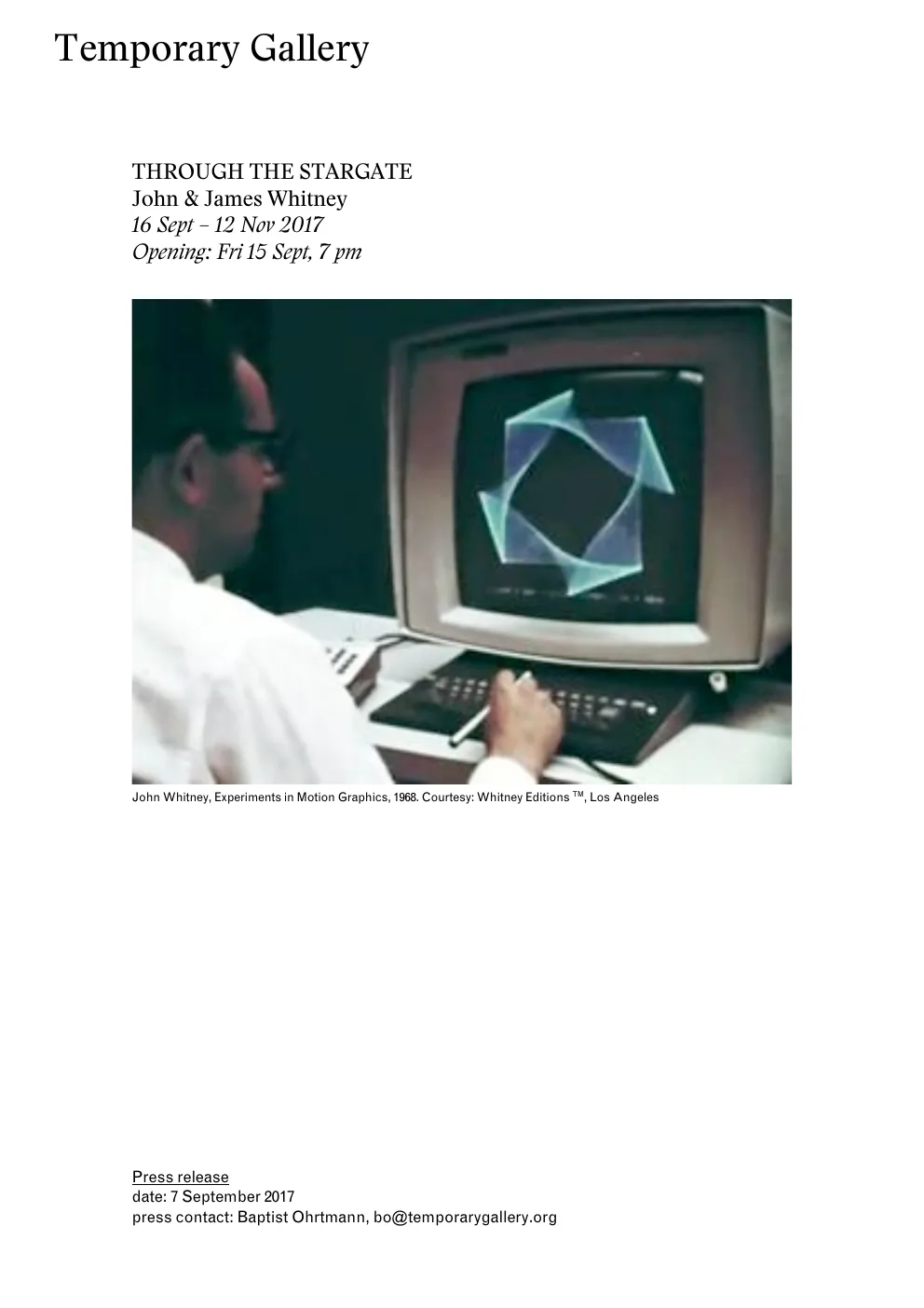
- An animator and a war-surplus computer. From 1957 John Whitney built drawing machines from outmoded analog military computers, trying to create “a correspondence between animated imagery and music” (People’s Graphic Design Archive). Animation World Network says the machine was built largely from surplus WWII anti-aircraft hardware, and that his 1960 sample reel ended on a Lissajous curve, multiplied many times over (AWN). Saul Bass repurposed some of Whitney’s cells for the spirals in the 1958 Vertigo titles (People’s GD Archive). After an IBM residency from 1966 to 1969, Whitney wrote Digital Harmony (1980), and kept composing visual music until he died in 1995 (AWN). We found no source linking Whitney to any later software author, so no line goes from him to Winamp.
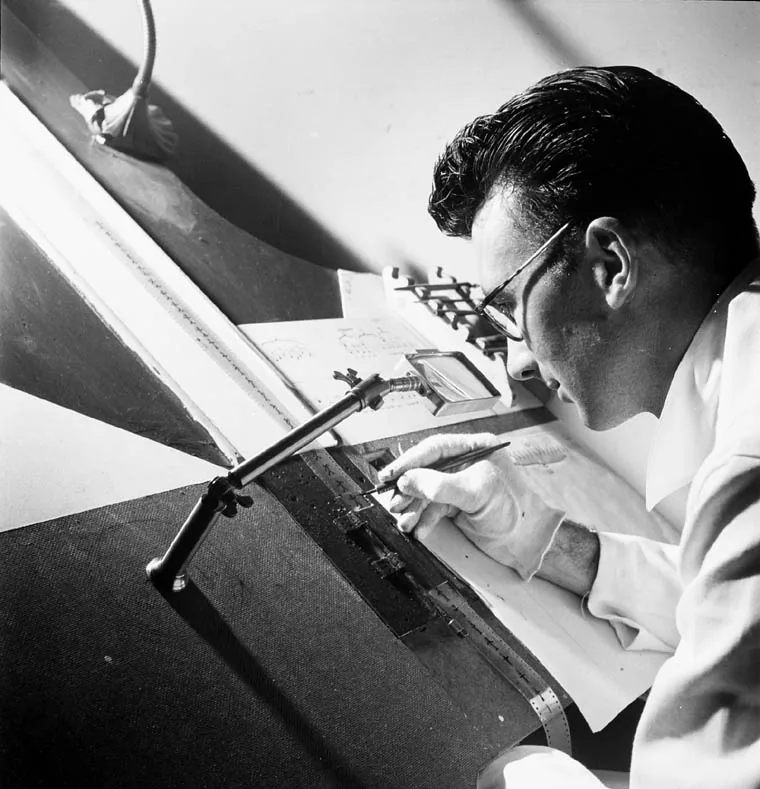
- A film-maker who drew the sound. Norman McLaren hand-drew on the optical soundtrack of film, so the picture was the sound. The National Film Board describes Pen Point Percussion as starting from an oscilloscope showing “what familiar sounds look like on the screen” (NFB; technical notes). That runs in the opposite direction to a visualizer, so we treat it as a cousin.
- The first light shows were hand-built. The Joshua Light Show performed with projectors, oil and water. Its own history quotes the New York Times in 1969 on Fillmore East: “Mondrianesque checkerboards, strawberry fields, orchards of lime, antique jewels” (joshualightshow.com).
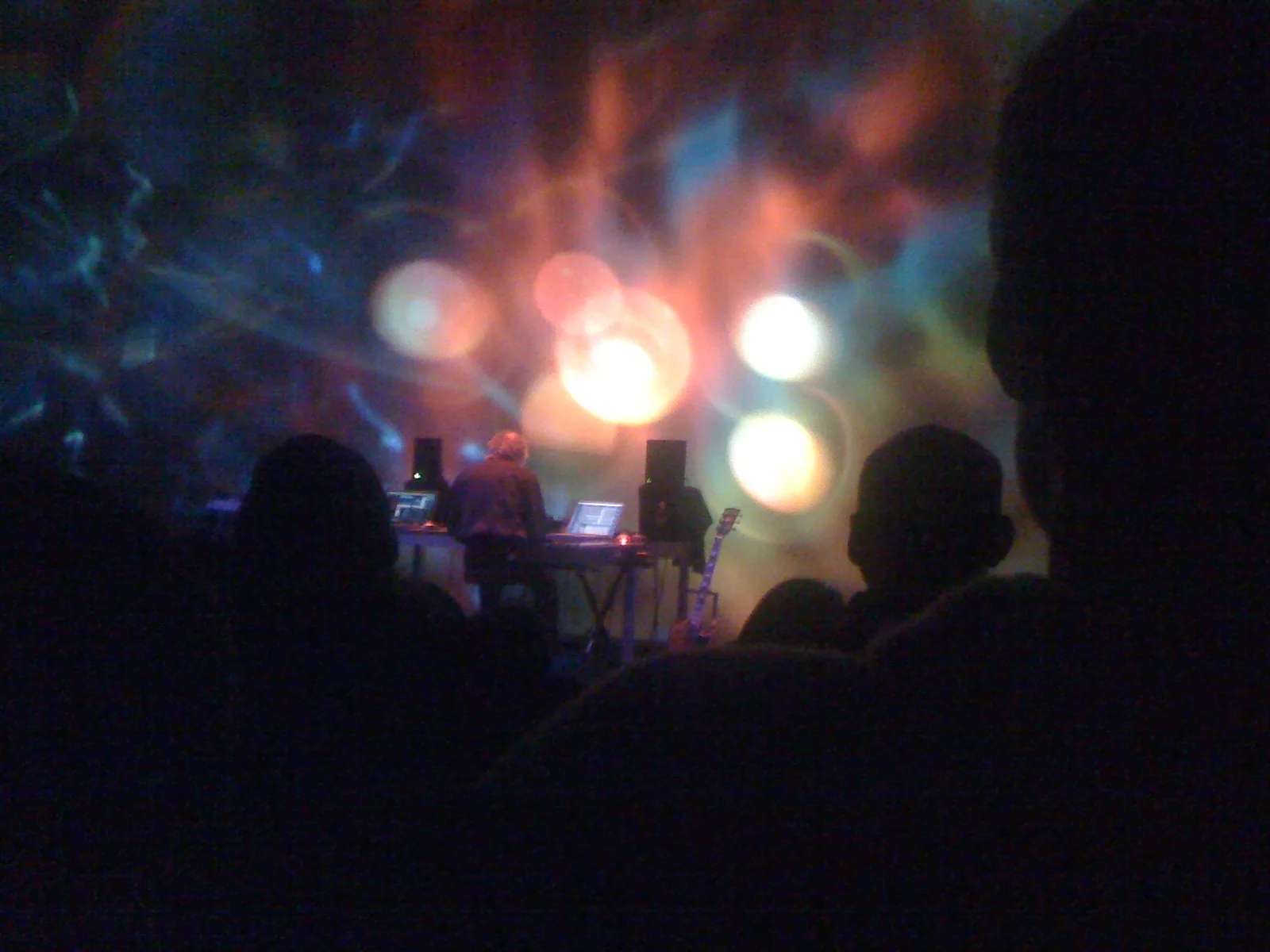
- A laser pioneer on Lissajous shapes. Science & Film’s profile says the first laser show was set to Copland’s Fanfare for the Common Man and was made by physicist Elsa Garmire. Of the X-Y mirror laser show at the Pepsi Pavilion at Expo ’70, she said the “wild pattern” of Lissajous figures “has no aesthetic value at all” (Science & Film).
- A British prototype got there first. Fred Judd’s Chromasonics, shown at the 1963 London Audio Fair, drove a modified TV from sound (Wikipedia). It was never sold and no source says Atari knew of it.
The honest summary of this branch: the idea “show sound as light” is very old, but we can’t document a direct line from any of these people to the software that follows. They are the roots, not the trunk.
2. The trick that kept being rediscovered
In the 1980s a British game programmer started releasing what he called light synthesizers. Jeff Minter’s Psychedelia (1984) was joystick-painted patterns with music. According to Minter’s own history page, one magazine called it “pointless hippy nonsense” (minotaurproject.co.uk).
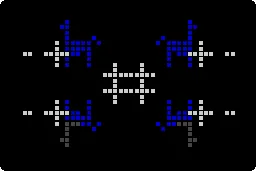
His later work is the backbone of this branch. All of what follows is from Minter’s own pages, so treat it as his account:
- In 1990 engineers at the chip company Inmos “stumbled across” his Trip-a-Tron, called him, and built VLM-0 on a Transputer. It was never sold, but he says it was used at raves and by The Shamen, Primal Scream and The Orb, and that he demoed it to Prince at Paisley Park on a “knackered old 286”.
- VLM-1 (1994) shipped in the firmware of the Atari Jaguar CD. Minter did the graphics and Ian Bennett the audio analysis. Its key idea was frame feedback: each frame starts as a modified copy of the last, so small movements grow into swirling patterns. Minter says he found it while making the game Tempest 2000.
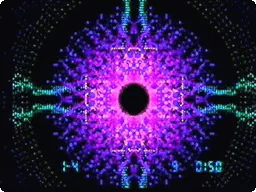
- He also says someone from Nullsoft apologized to him for “borrowing” the technique, and that he was “absolutely gutted” when an Apple iMac ad showed an iTunes visualizer using “substantially the same techniques”. We found no confirmation from Nullsoft or Apple, and the Nullsoft person is unnamed. We draw this as a dotted “same idea” line, not a lineage.
The other inventor tells a different origin. Ryan Geiss says he found his version while trying to make a smoke effect (Geiss, “how it worked”). Two people reaching the same trick independently, and both saying so in public, is a fair reading of the evidence.
The idea shows up once more in 2022. Nicolai Klemke, founder of Neural Frames, says he “stumbled on a technique from the deforum community” (origin story), and describes Deforum as “basically a giant image-to-image-to-image loop”. That is the same principle (feed the last frame into the next) applied to Stable Diffusion. Again: an analogy, not a lineage.
3. The Winamp years
Cthugha, Geiss and the demoscene
Geiss’s own write-up is unusually frank about where his ideas came from. The “warp map” trick was “admittedly inspired by many a demo from the incredible ‘demo scene’ in Europe”, and using the audio waveform as the seed “wasn’t exactly my original idea… I had seen a program called Cthugha a few years prior” (secrets.html). The placeholder name was “FX”; “Geiss” was a friend’s suggestion. Two Cyrix engineers taught him a memory-prefetch technique that gave a 30–40% speed boost (same page).
Cthugha was by Kevin “Zaph” Burfitt of Australia, started in Sept 1993 with version 2.0 public in March 1994, and was ported to Linux in 1995 and Winamp in 1998. Wikipedia quotes its tagline: “an oscilloscope on acid”. Burfitt abandoned it in January 2001 (Wikipedia, citing Usenet and HotWired).
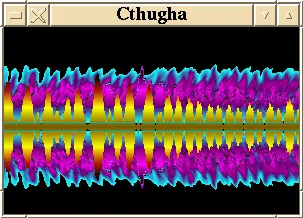
What the 1998 Geiss plug-in actually does: draw the waveform, then warp the previous image through a precomputed bilinear map. It ran on Winamp’s visualization plug-in interface, which Nullsoft had opened in 1997–98 (Geiss’s page, and Winamp history†).
MilkDrop and AVS
MilkDrop is Geiss’s GPU sequel, written while he worked at Nullsoft. Version 1.0 shipped on 5 Nov 2001 per Wikipedia. It added per-frame equations and a user-authored preset culture, and MilkDrop 2 (2007) added pixel shaders. Geiss says his GPU warp “is how Milkdrop works” (geisswerks). He also states that the 2007 update, called MilkDrop 2, “is the same program”.
AVS (Advanced Visualization Studio) was Nullsoft’s other path: stackable effects scripted in a small language called EEL. Nullsoft’s source and BSD licence were released in May 2005 (eWeek, 3 Jun 2005). The twist is that Justin Frankel, who co-created Winamp, later founded Cockos, and Cockos’s EEL2, “based on AVS’s EEL”, is the language inside REAPER’s JSFX effects (Cockos WDL, EEL2). A visualizer scripting language now runs inside a professional audio workstation. Frankel’s role at Cockos is from a secondary source†.
A parallel stream: trackers
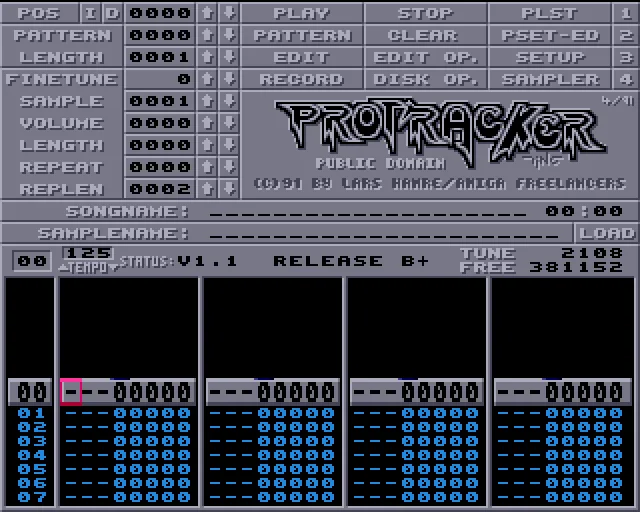
The tracker scene produced scopes before it produced visualizers. ProTracker 1.1A (Dec 1990) added a “Quadrascope”, a four-channel real-time oscilloscope that works “even when playing from keyboard”, with the old spectrum analyzer one click away. The authors were Amiga Freelancers, with the readme naming Lars and Anders Hamre (readme, version list). Open Cubic Player 0.9 for DOS was released at The Party 1994 (cubic.org). These are tools for a musician to see their own channels. No source connects them to Geiss or Winamp, so the diagram keeps them off the trunk.
4. The player years: iTunes, Media Player, Spotify
G-Force and the “2001 iTunes visualizer”
The version of the story that gets repeated is that iTunes shipped with G-Force. The evidence is thinner than it sounds.
- SoundSpectrum says so. The company’s milestone list reads: “2001 — Partnership with Apple Computer to build a special (personal use) version of G-Force for use within the iTunes music player” (SoundSpectrum). Its founder, Andy O’Meara, made WhiteCap in 1999 and G-Force in 2000 (same page).
- A reviewer thought so at the time. ATPM’s review of iTunes 1.0 (January 2001) said the one built-in plug-in “appears to be the famous G-Force plug-in from SoundJam” (ATPM). iTunes itself is widely reported to descend from SoundJam, which Casady & Greene sold, but the review treats that as rumor: “according to rumors… Neither Apple nor C&G officially said anything”.
- Apple didn’t name it. Apple’s press releases for iTunes 2 (23 Oct 2001) and iTunes 8 (9 Sep 2008) don’t mention a visualizer at all, so neither credits its maker.
So the safe sentence is: “SoundSpectrum says it partnered with Apple in 2001, and a January 2001 review thought iTunes 1.0’s built-in visual was G-Force.” Whether the iTunes 1.0 visual and the 2001 partnership are the same thing is one question we couldn’t settle.

A smaller link in the same family: ArKaos, the VJ software company, shipped a free “ArKaos Visualizer” plug-in “initially developed for Casady & Greene’s SoundJam”, with versions for iTunes, SoundJam and Audion (Macworld, 25 Sep 2001). That’s a rare bridge between the VJ branch and the player branch.
Magnetosphere: from a Processing sketch to every Mac
Robert Hodgin built Magnetosphere in the Processing creative-coding language. Fast forward and it’s the default iTunes visualizer. On the day iTunes 8 shipped, 9 Sep 2008, Make quoted a statement from the Barbarian Group, the studio behind the iTunes version: “Magnetosphere now lives in iTunes… The Barbarian Group no longer maintains, develops or owns Magnetosphere” (Make). Ars Technica’s hands-on the next day described the new visualizer as the former Magnetosphere (Ars†), and CDM had reported the rumor days earlier (CDM).
The date puzzle. Hodgin’s own project page says “2007” in one place and “November 2008” in another. We use September 2008, because that is what the company statement and contemporary press support1. Apple’s own iTunes 8 release never mentions it.
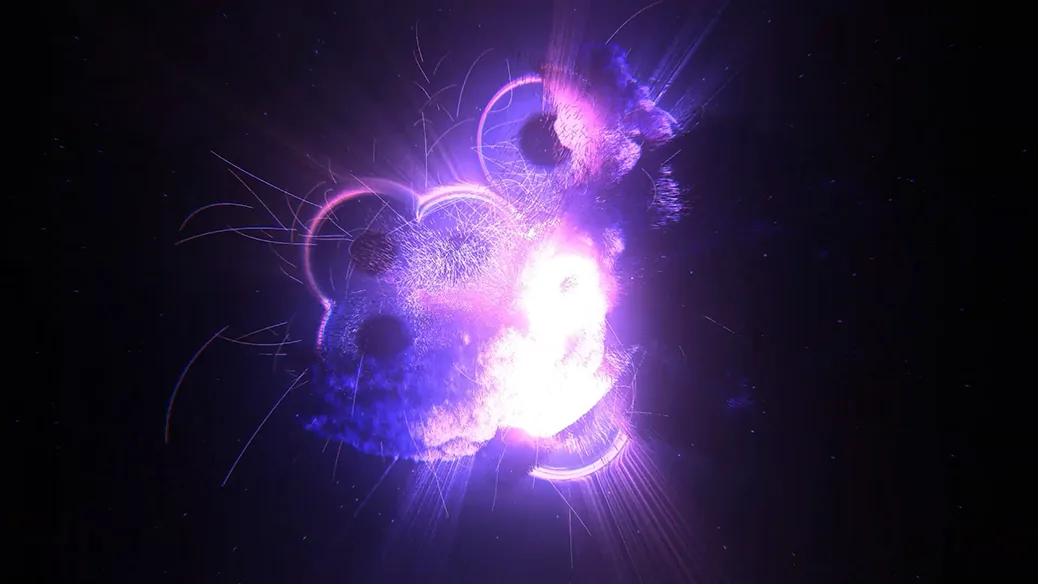
The port from Processing to C++ was done by Andrew Bell, and it led to Cinder, a C++ framework the Barbarian Group released in 2010 (libcinder.org†, CDM Q&A†).
Windows Media Player, PlayStation and the iPod
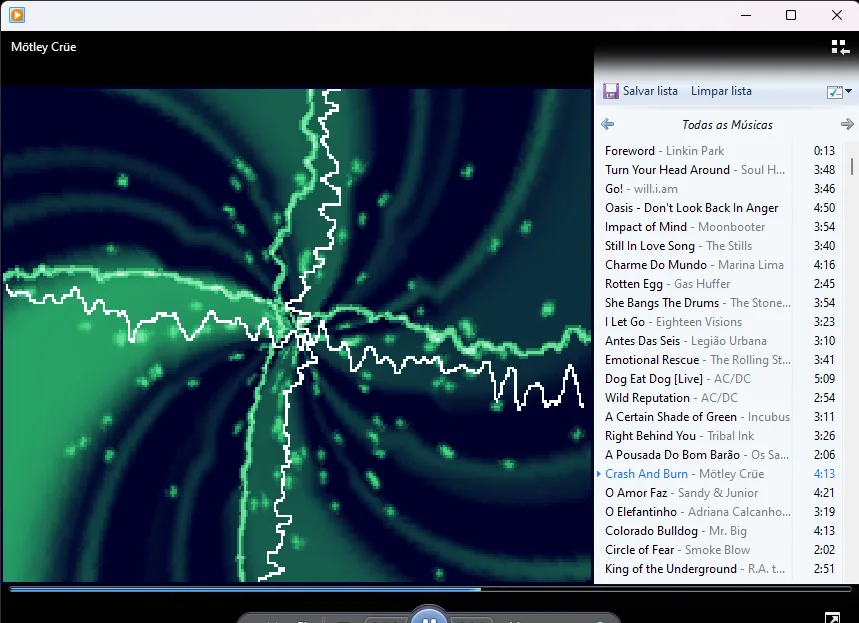
- Windows Media Player shipped visualizations such as Ambience (WMP 7, 1999) and Battery (WMP 8, 2001). We found no Microsoft page crediting individual authors. One fan wiki lists Battery’s developer as “Averrett & Microsoft” (wmpvis fandom, via Wayback), which we rate as weak and don’t repeat as fact. Windows 11’s new Media Player has none (Windows Insider blog†).
- The PlayStation 3 got a space-imagery visualizer from the Kyoto studio Q-Games in a December 2007 update, using NASA imagery (Ars†, Game Developer†).

- The iPod: we found no evidence of an audio visualizer on any iPod. Macworld’s September 2007 first look at the new nano and classic describes Cover Flow, not a visualizer (Macworld). This is absence of evidence, not proof, and we didn’t check every manual.
Spotify: a demo, not a feature
Spotify never shipped a visualizer in its main player, as far as we could find. What it did ship was a sample app. The spotify/visualizer-app repository’s first commit is dated 24 Sep 2013, and its README says it was provided as an example for the Apps platform: “By no means this is a finished product… This is strictly a demo” (GitHub). New app submissions closed on 24 Mar 2014, and the repo was cleared in March 2015 (same page, commit history).
A second door closed in November 2024, when Spotify restricted its Web API’s audio-analysis and audio-features data for new apps (Spotify developer blog). That is the data that browser visualizers such as Kaleidosync used; its README says it began with Spotify’s pre-computed beat and segment analysis (from Echo Nest) and later moved to real-time analysis (Kaleidosync). In 2019 Spotify launched Canvas, a short looping artist video behind the track†; calling it a replacement for visualizers is our reading, not Spotify’s (Spotify for Artists†).
5. The afterlives: the code that wouldn’t die
MilkDrop is the best case study in the family, because it died as a company product and lived on as other people’s code.
- projectM started in 2003, with a first release in April 2004. In the announcement, Peter Sperl says he and a friend rewrote MilkDrop in OpenGL after “nine months of reverse engineering” because “the WORST thing about it was no Milkdrop” on Linux† (Winamp forum, 4 Apr 2004†). It’s now a library (LGPL-2.1) that others build in (projectM).

- BeatDrop (2015, Maxim Volskiy) forked MilkDrop 2’s BSD source and added system-audio capture (BeatDrop). From it came NestDrop (2019, NEST Immersion, a Canadian fulldome company) with a curated library from about 52,000 community presets, and MilkDrop 3 (2023), which says it is “based on BeatDrop” (MilkDrop3, NestDrop manual). Today, a 2001 Winamp plug-in lives in planetarium domes.
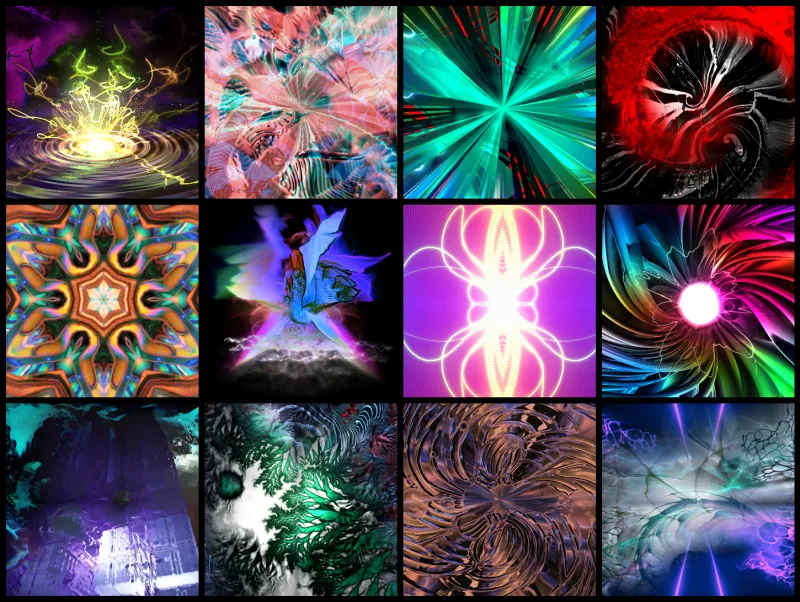
- Butterchurn (2018, Jordan Berg) reimplemented MilkDrop 2 in WebGL, and runs the same preset files. Eldredge has described it on Hacker News as “a new implementation, not a port” (Butterchurn, HN†). Webamp (Jordan Eldredge) added it in July 2018, and Eldredge’s eel-wasm (2020) compiles MilkDrop’s expressions to WebAssembly, about 72.6% faster in his benchmark (post).
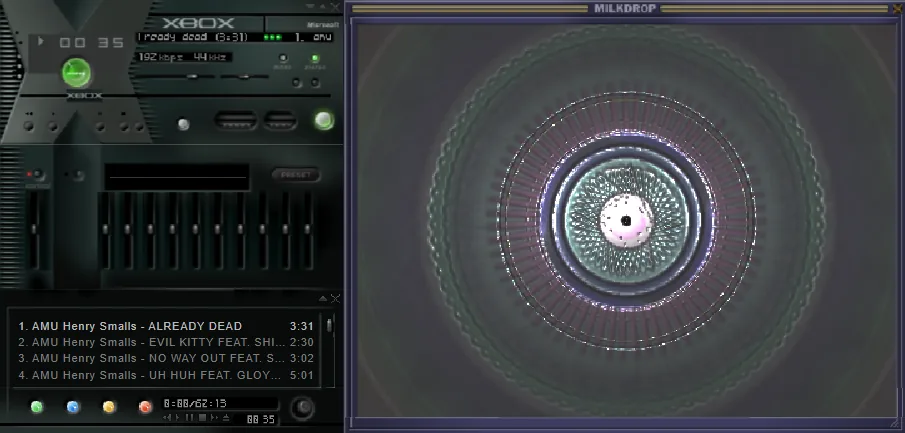
- Winamp itself published a “Legacy Player Code” release on 24 Sep 2024. Its licence forbade distributing modified versions, and the repo was gone by mid-October (Ars Technica, The Register). Meanwhile AVS had been BSD-licensed since 2005 and MilkDrop 2 since 2013.
- The author came back. Ryan Geiss released Geiss HDR, a browser rewrite for HDR displays, on 10 Mar 2026, 28 years after the original (geisswerks.com). The 1998 plug-in’s source had been released in December 2022 (geiss repo).
6. The live branch: VJs, nodes and shaders
This branch has the best-documented family relations on the tree, mostly because its founders keep writing their histories.
- ArKaos to VDMX. VIDVOX’s Johnny DeKam says: “I also started working with the first ARKAOS app, which is what really inspired me to write my own video software… This was the genesis of VIDVOX” (VDMX blog). ArKaos was founded by Belgian Marco Hinic, who died in 2021 (mothergrid†).
- Houdini to TouchDesigner. Derivative, founded in 2000 as a spin-off from Side Effects, brought with it what its retrospective calls a gift: “Houdini 4.1 source code” (Derivative retrospective). The retrospective also tells of the 2003 MUTEK show where the screen went dark because a projector shutter closed, not because the software crashed.
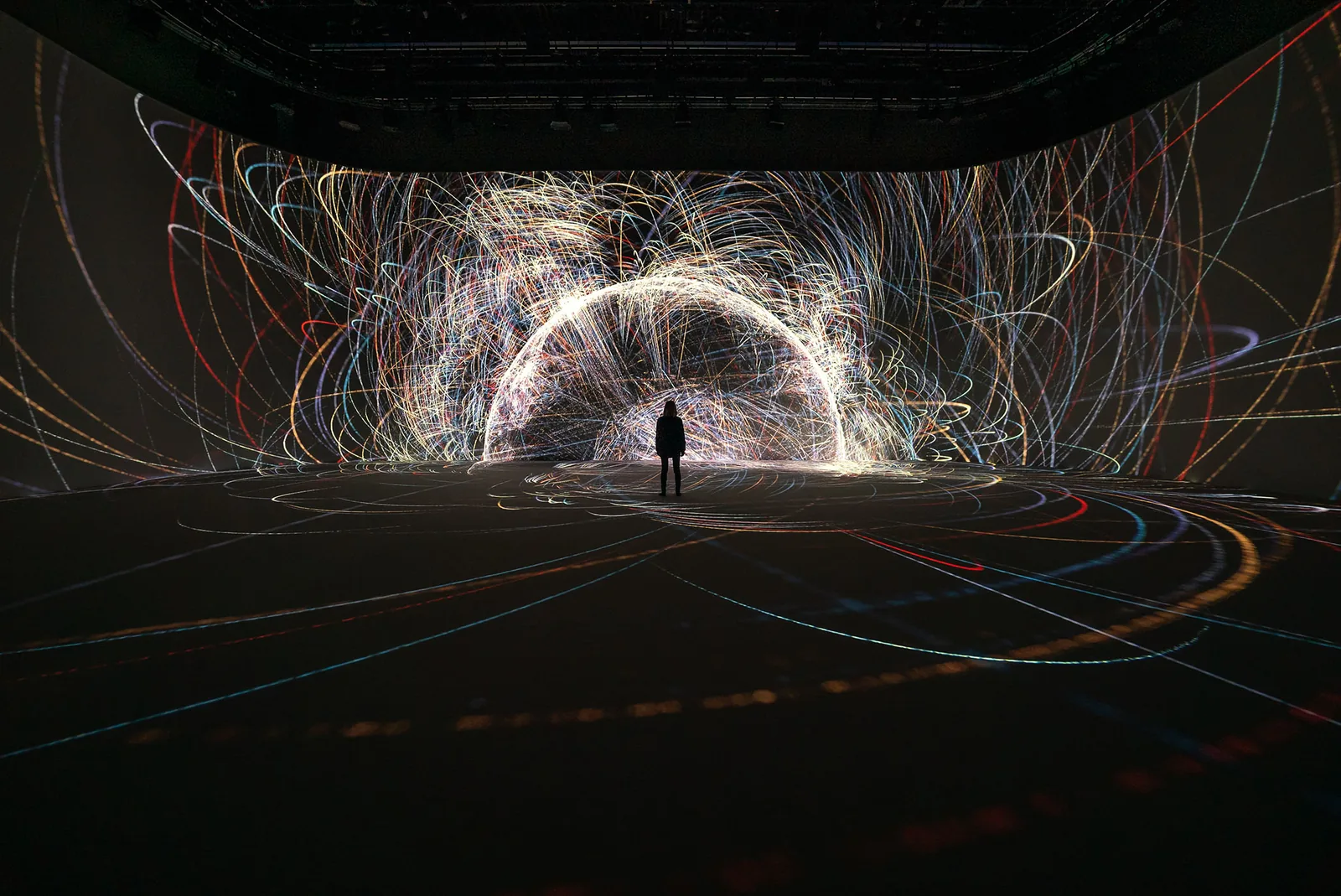
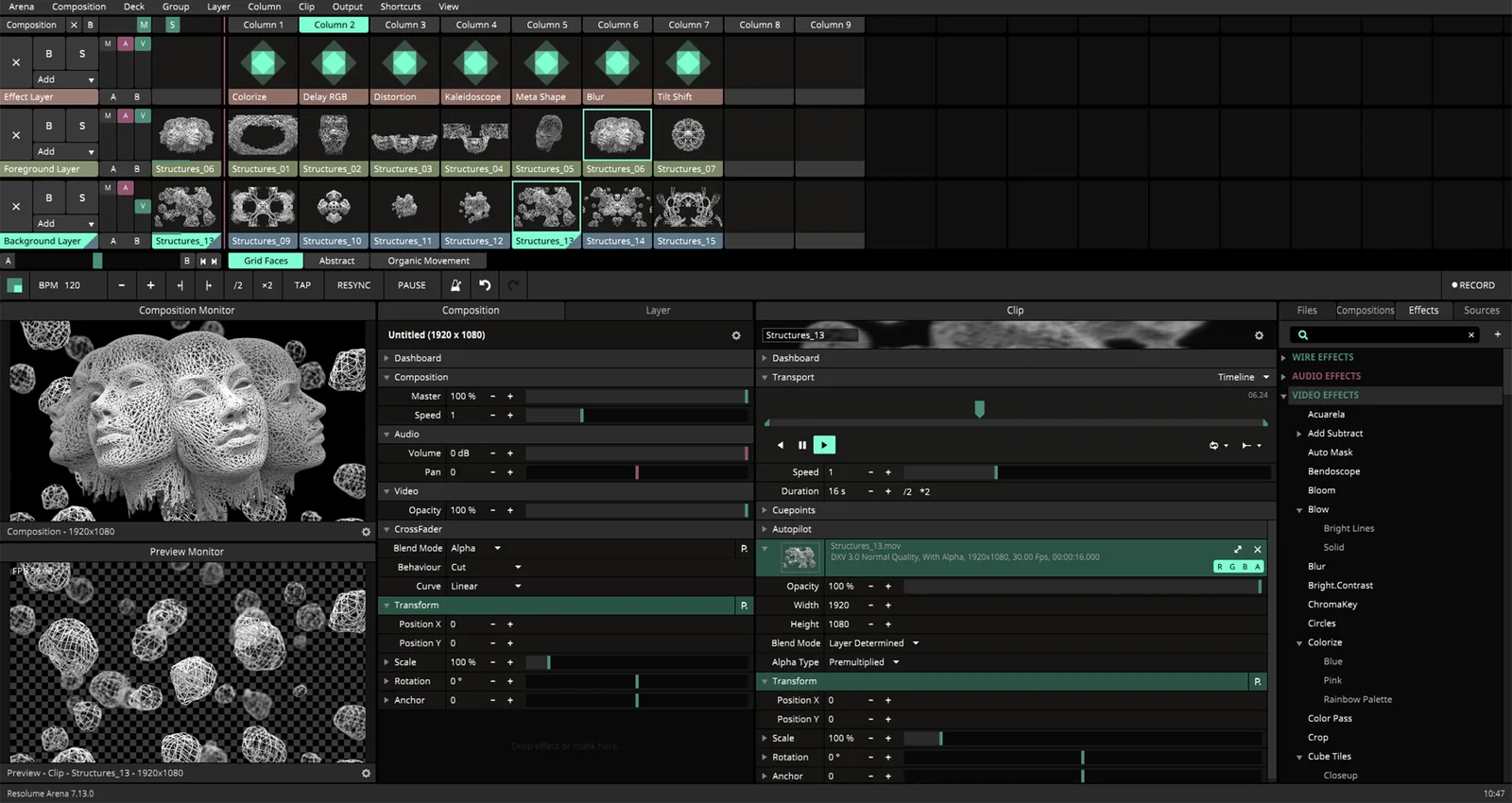
- Resolume began in 1998 as a way to replace VHS tapes and a Panasonic MX50 mixer (Edwin de Koning and Bart van der Ploeg; company page).
- Demoscene to Notch. Notch started as DemolitionFX, a tool of the Fairlight demo group, and went public in September 2016 (pouet.net thread).
- Shadertoy to Synesthesia. Shadertoy launched in early 2013 by Íñigo Quílez and Pol Jeremias (Quílez resume). Synesthesia’s own docs include “How to Manually Convert from Shadertoy.com to SSF” (docs). Its maker, Gravity Current, Inc., was “founded in 2015 by college friends Theron Pray and Joe Brown”, who formed an experimental electronic band and couldn’t find visuals that reacted to their music (press release, 16 Mar 2016).

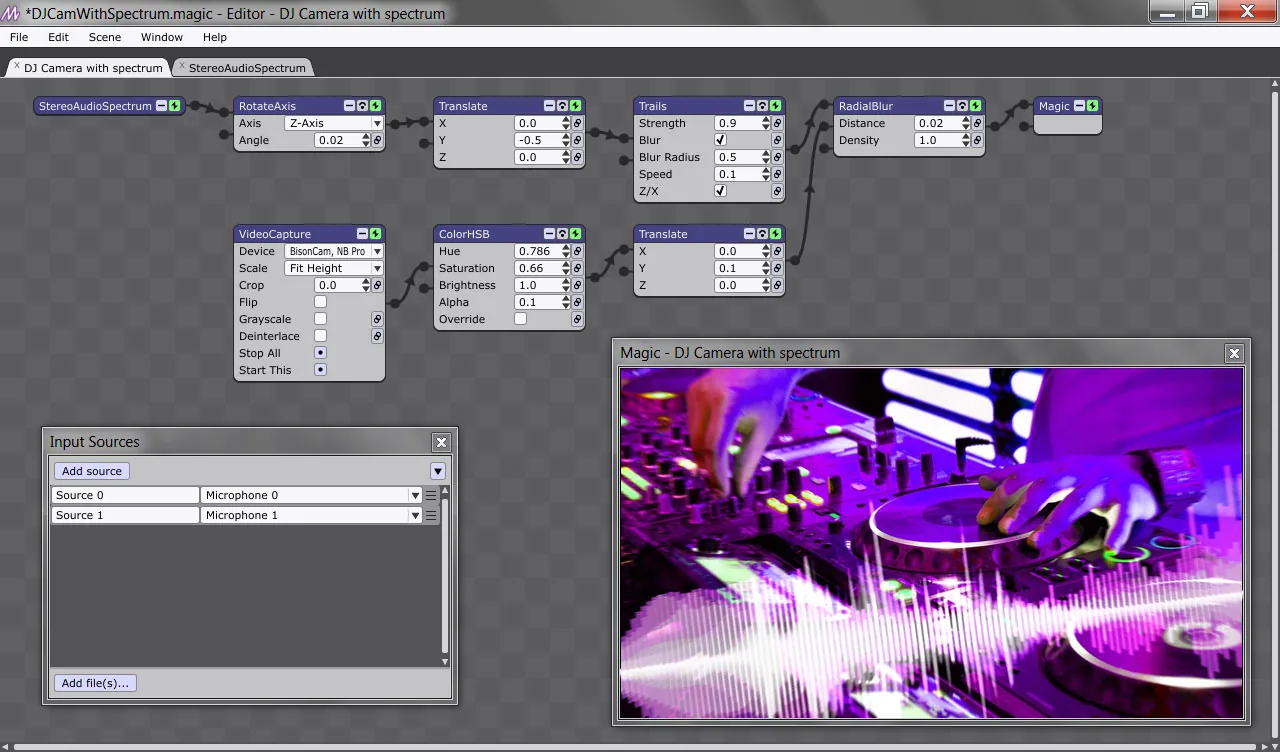
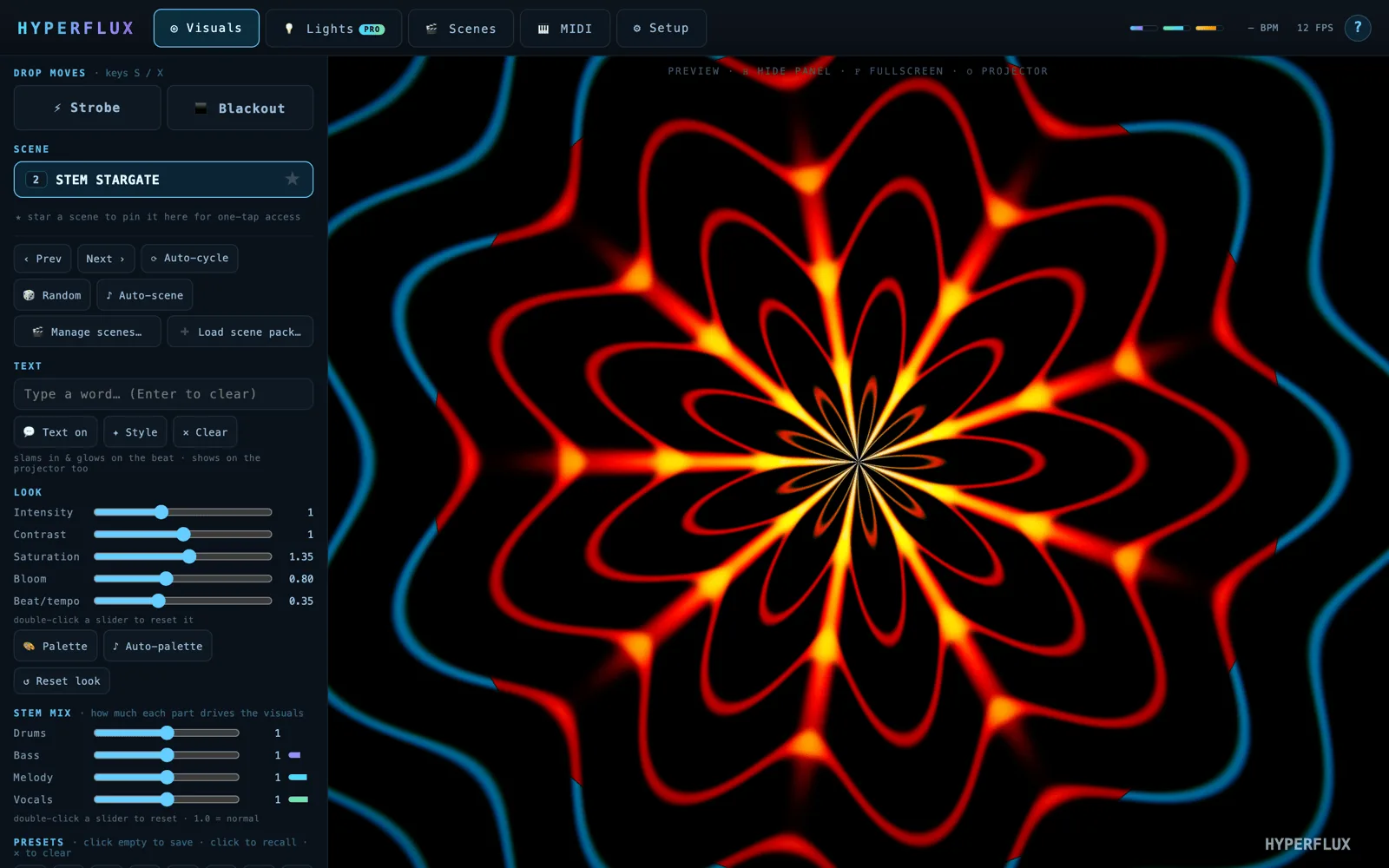
- Others. Magic Music Visuals says it was founded in Los Angeles in 2012 (its About page, via Wayback); we couldn’t find founder names. HYPERFLUX, a newer stem-reactive VJ and lighting app, publishes no company, founder or date on its site (hyperfluxvj.com). We list its origin as unknown.
7. The creator years: the visualizer becomes a video format
Between about 2006 and 2016 the tools moved into the browser and the video editor. We found no source saying one caused the next, so these are parallel developments:
- Adobe’s ActionScript 3
SoundMixer.computeSpectrumgave Flash direct access to frequency data in 2006† (Mike Chambers†). The W3C published the first Web Audio working draft on 7 Nov 2011†, and the standard became a W3C Recommendation on 17 Jun 2021 (W3C history†). - FFmpeg 1.0 (Sept 2012) added
showwavesandshowspectrum, so a server could render a visualizer video from the command line (Changelog).
The look everybody knows (and who made it: unknown)
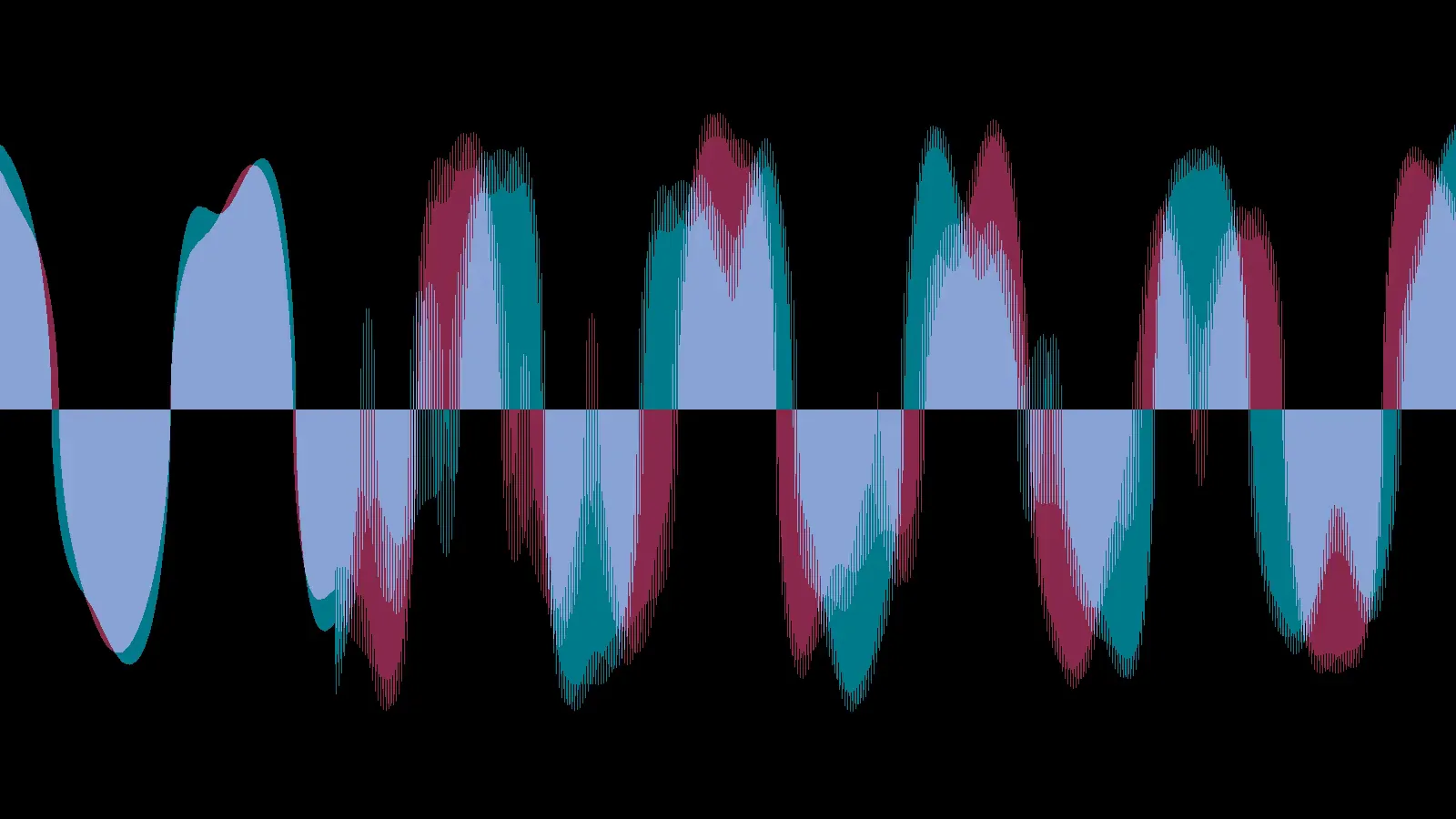
YouTube is full of tracks uploaded with a spectrum visualizer over artwork, with bars (the “Monstercat look”) or a circle (the “Trap Nation look”). We looked for who started it and found no creator statement.
- A Reddit thread says Monstercat made theirs with the After Effects plug-in Trapcode Sound Keys, crediting an editor called “Chung”†. We could not open the thread directly. Fans’ memory is the only source, so treat it as unverified (r/Monstercat†).
- Trap Nation’s founder is Andre Benz. An interview says he created the channel in 2012, first named “All Trap Nation” (Independent Music Insider, 11 May 2021). Wikipedia says it was co-founded in September 2012 by Benz and Kevin Field (Wikipedia). We found no source saying who made the circular visualizer, so we credit no one.

- Sound Keys itself was made by Peder Norrby’s Trapcode, and Red Giant became its publisher in 2006† (Videomaker†).
Template sites turned that look into a product, with different stories:
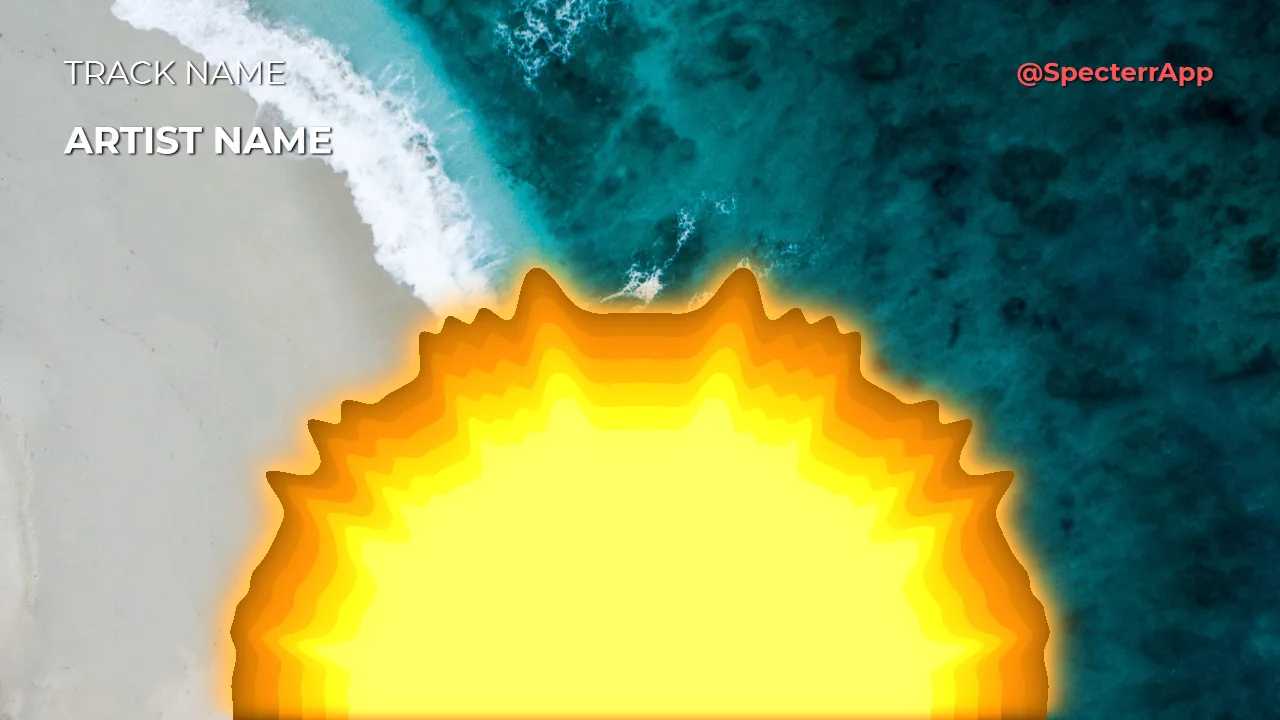
- Specterr was called Vizfly until 14 Jul 2020 (Specterr blog).
- Videobolt launched in 2016 as a Serbian video-production platform (startit.rs); when it added visualizer templates is unknown.
- Renderforest, founded in 2013 in Yerevan by Narek Safaryan (About), does not say when its visualizer templates arrived.
- Avee Player appeared on Google Play in 2016 under the developer name “Daaw Aww” (AppBrain); the person behind it is unknown to us.
Audiograms: public radio, then everyone
WNYC launched its Audiogram tool in March 2016, with the concept by Delaney Simmons and the build by Noah Veltman (Nieman Lab, 8 Mar 2016). It was open-sourced as MIT-licensed code (repo). Headliner’s team says they first hosted that open-source tool for anyone to use: “So we stopped everything on our app and started building Headliner” (Headliner blog).

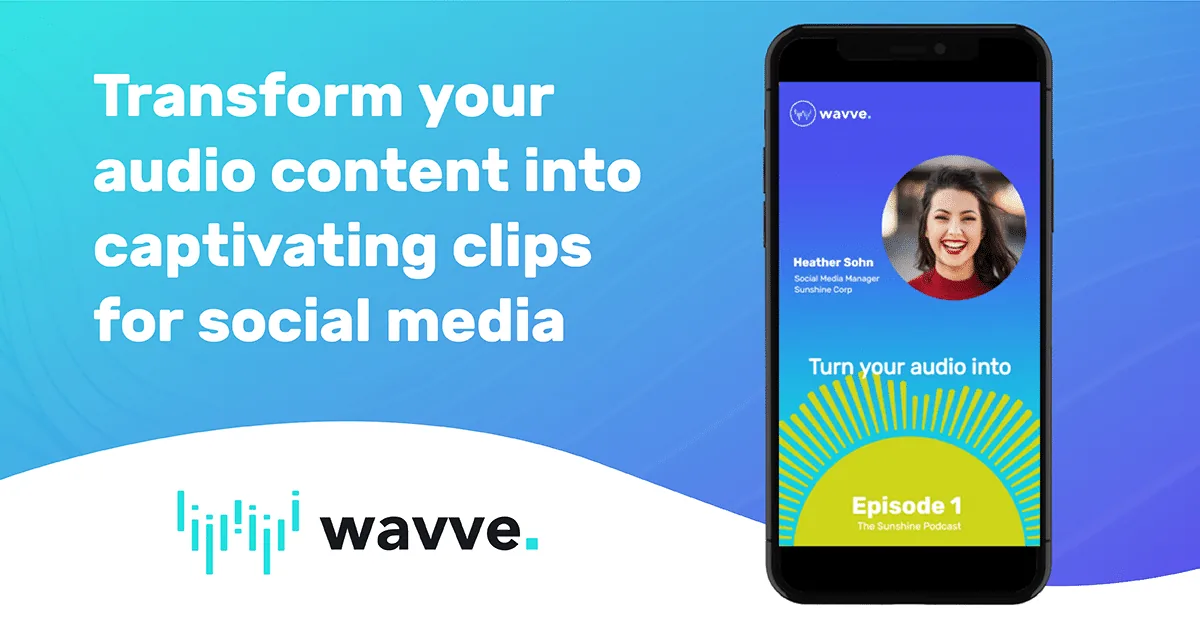
Wavve is a separate story. Its founders say they started it in April 2016, a month after WNYC’s launch, to promote their own audio apps, and the founders said in a February 2017 interview that they had launched their newest product about three months earlier (Hypepotamus, 20 Feb 2017). The founders named there are Baird Hall and Nick Fogle. Wavve says it is now a subsidiary of Disctopia Inc. (wavve.co). We found no evidence of any link to Audiogram, so there is no line between them.
8. Stems and AI
Splitting a song into drums, bass, vocals and the rest used to be a studio job. In 2019, Deezer’s Spleeter (repo created 26 Sep 2019) and Facebook AI Research’s Demucs (paper Sept 2019, by Alexandre Défossez) made it a download (Spleeter, Demucs, arXiv 1909.01174). “Stem-reactive” visualizers followed. The natural question is which separator each uses, and the answer from the tools themselves is: mostly not stated.
| Tool | What it says about stems | Names a separation model? |
|---|---|---|
| Neural Frames | “Our proprietary audio analysis extracts 8 different stems” (product page) | No (“proprietary”) |
| HYPERFLUX | Four stems (drums, bass, melody, vocals); “real-time analysis, no file pre-processing” (features) | No |
| Synesthesia | We found no stem separation in its docs | n/a |
| Sonir (open source, Dec 2025) | “Automatic separation of Drums, Bass, Other, Vocals (using Demucs)” (README) | Yes, Demucs |
| Stem-Separator (open source, Apr 2025) | Streamlit app using Demucs, with Three.js visuals (README) | Yes, Demucs |
| WaveMotion (ours) | Analyzes stems you provide; automatic splitting is listed as “coming soon”† (wavemotion.app) | Not applicable yet |
We checked the tools above and found no commercial visualizer that says it uses Demucs or Spleeter. We did not check Kaiber, Specterr, Beatsee or Freebeat.
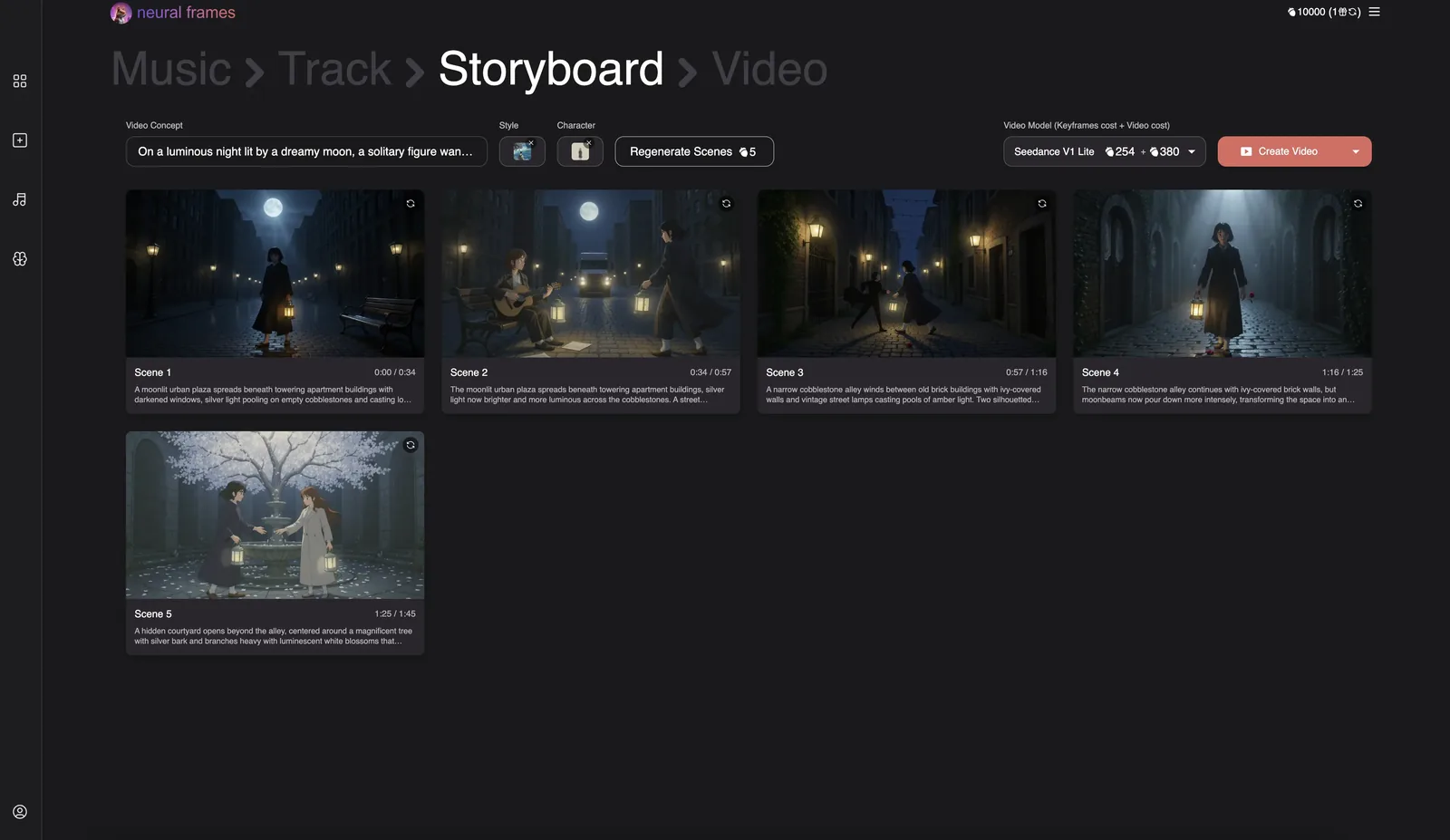
The other AI line is Deforum, a Stable Diffusion animation notebook from August 2022 that loops an image through img2img with keyframed zoom (search summary†). Audio-to-keyframe add-ons appeared within two months, including nicolai256’s (Sept 2022) and Parseq (Oct 2022). Klemke’s Neural Frames (v1 in January 2023, relaunched April 2023†) says it grew out of Deforum (origin story). The GitHub user “nicolai256” shares a first name with Klemke. We found no evidence they’re the same person and don’t imply it. Kaiber, launched out of beta in May 2023†, is another entry on this branch, but we only have secondary reports of its early history.
9. What the tree teaches
- Ideas are rediscovered. Minter and Geiss each found frame feedback and said so. The oscilloscope X-Y display of 1950s electronic art reappears in FFmpeg’s
avectorscopefilter. The filter is documented (Changelog), but nobody says the first led to the second; it is the same shape found again.

- Open code outlives companies. Winamp’s own 2024 source release collapsed within weeks, but MilkDrop’s source (released in 2005 and under BSD in 2013) still runs in browsers, domes and Linux players.
- Preset communities outlive apps. The curated NestDrop library draws on about 52,000 community presets. Geiss’s 2021 “favorites” pack picks from NestDrop’s own “cream of the crop” pack (geisswerks.com).
- Platform owners decide. Spotify’s sample visualizer and its Apps platform went away in 2014–15, and its beat data was restricted in 2024. Apple’s visualizers changed when Apple bought or licensed one.
- The least-documented layer is the most popular one. We can tell you who wrote MilkDrop, but not who invented the YouTube spectrum-over-artwork look.
The tree, simplified
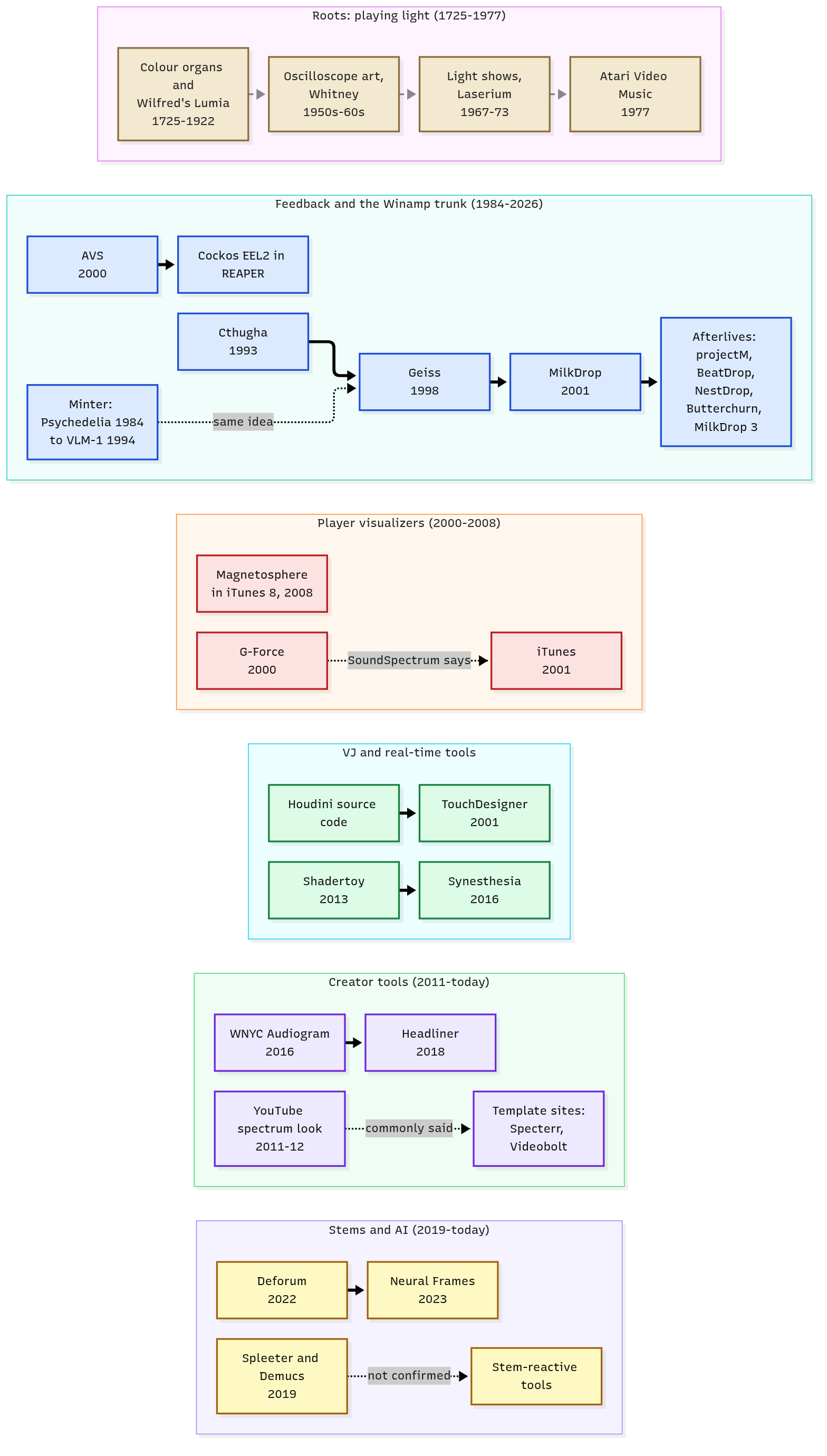
(Deliberate omissions: Atari to Minter, Atari to Cthugha, MilkDrop to G-Force, and every other cross-branch line, because we found no source for them.)
On this site: Desktop and player visualizers · MilkDrop, projectM, Butterchurn and player visualizers · Live visualizers for VJs, DJs and streamers · HYPERFLUX alternatives · Stem-reactive music visualizers · AI music video generators · Best audiogram makers · Spotify Canvas makers · Renderforest and Videobolt alternatives · Make an audio visualizer with FFmpeg · DIY: FFmpeg, libraries and code · Tool directory · About
Sources
Opened and read for this draft unless marked †. Grade in brackets.
Roots
- US Patent 4,081,829, Atari (Brown). [A1] https://patents.google.com/patent/US4081829
- atarivideomusic.net: inventor and history. [B] https://atarivideomusic.net/inventor/ · https://atarivideomusic.net/history/
- RR Auction lot, Allan Alcorn’s sealed C-240. [B] https://www.rrauction.com/auctions/lot-detail/346153906445003-allan-alcorn-atari-video-music-model-c240-unopened/
- Wikipedia: Thomas Wilfred. [B] https://en.wikipedia.org/wiki/Thomas_Wilfred
- Center for Visual Music: Fischinger’s Lumigraph. [B] https://centerforvisualmusic.org/Fischinger/Lumigraph.htm
- People’s Graphic Design Archive, “Catalog” (Whitney). [B] https://peoplesgdarchive.org/item/3134/catalog
- Animation World Network, “Digital Harmony”. [B] https://www.awn.com/animationworld/digital-harmony-life-john-whitney-computer-animation-pioneer
- National Film Board: Pen Point Percussion, McLaren technical notes. [A1] https://www.nfb.ca/film/pen_point_percussion/ · https://www3.nfb.ca/archives_mclaren/notech/NT_EN.pdf
- Joshua Light Show history page. [A1] https://www.joshualightshow.com/about-classic/joshua-light-show-1967-68
- Science & Film, “Creatures of Light: Laserium”. [B] https://scienceandfilm.org/articles/creatures-of-light-laserium/
- Wikipedia: Fred Judd. [B] https://en.wikipedia.org/wiki/Fred_Judd
- † Castel and Rimington: Oxford ORA thesis https://ora.ox.ac.uk/objects/uuid:c24ea518-fb73-4f34-874e-f9398d678903/files/dm039k5094 · rhythmiclight.com PDF https://rhythmiclight.com/1998/articles/InstrumentsToPerformColor.pdf [B]
Feedback and Winamp trunk 13. Jeff Minter pages. [A1] http://www.minotaurproject.co.uk/psychedelia.php · http://www.minotaurproject.co.uk/vlm.php 14. Geiss: how it worked; MilkDrop. [A1] https://www.geisswerks.com/geiss/secrets.html · https://www.geisswerks.com/about_milkdrop.html · https://www.geisswerks.com/ 15. Wikipedia: Cthugha; MilkDrop. [B] https://en.wikipedia.org/wiki/Cthugha_%28software%29 · https://en.wikipedia.org/wiki/MilkDrop 16. AVS source and licence. [A1] https://www.1014.org/code/nullsoft/avs/ · eWeek [B] https://www.eweek.com/servers/aol-opens-up-audio-video-technology/ 17. Cockos WDL and EEL2. [A1] https://www.cockos.com/wdl/ · https://www.cockos.com/EEL2/ 18. ProTracker readme and version list. [A1] https://github.com/cmatsuoka/tracker-history/tree/master/reference/amiga/protracker 19. Cubic Player. [A1] https://cubic.org/player/ 20. projectM, BeatDrop, MilkDrop 3, Butterchurn, Webamp, geiss. [A1/A2] https://github.com/projectM-visualizer/projectm · https://github.com/mvsoft74/BeatDrop · https://github.com/milkdrop2077/MilkDrop3 · https://github.com/jberg/butterchurn · https://github.com/geissomatik/geiss 21. † projectM announcement, Winamp forums. https://forums.winamp.com/forum/visualizations/milkdrop/151664-projectm-milkdrop-for-linux-released 22. NestDrop manual. [A1] https://nestimmersion.ca/assets/nestdrop_user_manual_V23.pdf 23. eel-wasm post (Eldredge). [A1] https://jordaneldredge.com/speeding-up-winamps-music-visualizer-with-webassembly/ 24. Ars Technica and The Register on Winamp’s 2024 release. [B] https://arstechnica.com/gadgets/2024/10/winamp-really-whips-open-source-coders-into-frenzy-with-its-source-release/ · https://www.theregister.com/software/2024/10/16/releasing-winamp-source-goes-badly-for-its-owners-anyway/417709
Players 25. SoundSpectrum about page. [A1, one-sided] https://www.soundspectrum.com/about.html 26. ATPM, review of iTunes 1.0. [B] https://www.atpm.com/7.02/itunes.shtml 27. Apple, iTunes 8 press release. [A1] https://www.apple.com/newsroom/2008/09/09Apple-Announces-iTunes-8/ 28. Macworld, ArKaos Visualizer for iTunes (25 Sep 2001). [B] https://www.macworld.com/article/163034/itunes-8.html 29. Make, 9 Sep 2008 (quotes Barbarian Group). [B] https://makezine.com/article/maker-news/apples-new-itunes-visuali/ 30. CDM, rumor post. [B] https://cdm.link/flight404s-magnetosphere-the-new-visualizer-in-itunes-8/ · † Ars Technica hands-on https://arstechnica.com/gadgets/2008/09/hands-on-itunes-8-rethinks-features-and-rocks-new-ones/ 31. Robert Hodgin, Magnetosphere page. [A1] https://roberthodgin.com/project/magnetosphere 32. † Cinder: https://www.libcinder.org/about · https://cdm.link/meet-cinder-free-barbarian-group-code-framework-produces-stunning-work-qa/ 33. † WMP: wmpvis fandom (via Wayback) [C] https://wmpvis.fandom.com/wiki/Battery · Windows Insider blog https://blogs.windows.com/windows-insider/2021/11/16/new-media-player-for-windows-11-begins-rolling-out-to-windows-insiders/ 34. † PS3 visualizer: https://arstechnica.com/gaming/2007/12/nasa-q-games-honor-gaia-with-new-ps3-visualizer/ · https://www.gamedeveloper.com/game-platforms/special-q-games-on-ps3-s-gaia-music-visualizer 35. Macworld, iPod first look (Sept 2007). [B] https://www.macworld.com/article/187228/ipod_firstlook.html 36. Spotify: visualizer-app; developer blog 27 Nov 2024; Kaleidosync. [A1] https://github.com/spotify/visualizer-app · https://developer.spotify.com/blog/2024-11-27-changes-to-the-web-api · https://github.com/zachwinter/kaleidosync 37. † Spotify Canvas. https://artists.spotify.com/blog/canvas-your-art-has-the-power-to-move
VJ and live 38. VDMX blog, Johnny DeKam interview. [A1] https://vdmx.vidvox.net/blog/johnny-dekam-pt1 39. † mothergrid on Marco Hinic. https://www.mothergrid.de/story/zum-tod-von-arkaos-gruender-marco-hinic/ 40. Derivative 20-year retrospective. [A1] https://derivative.ca/community-post/derivative-20-year-retrospective-part-1/62571 41. Resolume company page. [A1] https://resolume.com/company 42. pouet.net thread (Notch). [B/A1] https://www.pouet.net/topic.php?page=1&which=10844 43. Íñigo Quílez resume (Shadertoy). [A1] https://iquilezles.org/personal/resume/ 44. Synesthesia SSF docs; Harmony Central press release. [A1] https://app.synesthesia.live/docs/ssf/ssf.html · https://www.harmonycentral.com/news/live-sound/nows-your-chance-to-experience-synesthesia-r31764/ 45. Magic Music Visuals About (Wayback). [A1] https://web.archive.org/web/2024/https://magicmusicvisuals.com/about 46. HYPERFLUX site. https://www.hyperfluxvj.com/features
Creator tools 47. † Flash computeSpectrum; W3C Web Audio history. https://www.mikechambers.com/blog/post/2006-04-24-example-actionscript-3-computespectrum/ · https://www.w3.org/standards/history/webaudio-1.0/ 48. FFmpeg Changelog. [A1] https://github.com/FFmpeg/FFmpeg/blob/master/Changelog 49. † r/Monstercat thread [C]. https://www.reddit.com/r/Monstercat/comments/4jxl4l/probably_asked_before_how_does_monstercat_make/ 50. Independent Music Insider; Wikipedia: Trap Nation. [B] https://independentmusicinsider.com/editorial-articles/keatly-haldeman-x-andre-benz-the-past-present-and-future-of-trap-nation/ · https://en.wikipedia.org/wiki/Trap_Nation 51. † Videomaker on Trapcode and Red Giant. https://www.videomaker.com/videonews/2006/11/red-giant-software-partners-with-trapcode/ 52. Specterr blog (rename); Renderforest About; startit.rs on Videobolt; AppBrain (Avee). https://specterr.com/blog/vizfly-is-now-specterr/ · https://www.renderforest.com/about/ · https://startit.rs/domaci-videobolt-mesecno-poseti-vise-od-100-000-korisnika/ · https://www.appbrain.com/app/avee-music-player-pro/com.daaw.avee 53. Nieman Lab (WNYC Audiogram); Audiogram repo; Headliner blog. https://www.niemanlab.org/2016/03/hoping-to-make-audio-more-shareable-wnyc-introduces-audiograms-for-social-media/ · https://github.com/nypublicradio/audiogram · https://www.headliner.app/blog/2021/01/28/a-look-back-at-2020/ 54. Hypepotamus Q&A with Wavve’s founders; wavve.co. [A1] https://www.hypepotamus.com/wavve/ · https://wavve.co
Stems and AI 55. Spleeter; Demucs; arXiv. [A1] https://github.com/deezer/spleeter · https://github.com/facebookresearch/demucs · https://arxiv.org/abs/1909.01174 56. Neural Frames product page; founder’s origin story. [A1] https://www.neuralframes.com/product · https://nicos-neural-notes.beehiiv.com/p/the-neural-frames-origin-story 57. Sonir; Stem-Separator READMEs. [A1] https://github.com/Pomilon/Sonir · https://github.com/PMosby/Stem-Separator 58. WaveMotion (ours). † https://wavemotion.app 59. † Deforum summary; audio-keyframe forks. https://multimodalaiart.substack.com/p/1-week-of-stable-diffusion · https://github.com/nicolai256/audio_keyframe_deforum_DD_0.5 · https://github.com/rewbs/sd-parseq/
Footnotes
-
Hodgin’s page dates the iTunes port to 2007 in one paragraph and November 2008 in another. The Barbarian Group’s statement was quoted by Make on 9 Sep 2008, the same day iTunes 8 was announced, and Apple’s announcement date is on Apple’s own site. We read “2007” as either an error or the development year, and flag it for a question to Hodgin. ↩
Questions
Who made the first music visualizer?
It depends on what counts. If you mean a product for sale that turned stereo audio into pictures on a TV, the earliest we found is Atari's Video Music (patent filed Aug 1976, on sale 1977). Earlier people made instruments that played light, drew sound or fed an oscilloscope; none is a visualizer in the modern sense, and we found no source tying them to the Atari team.
Did Apple make iTunes' visualizer?
Not as far as we can show. The 2001 visual was, per SoundSpectrum, a special version of G-Force made in a partnership with Apple, and a January 2001 review thought it was G-Force. The 2008 visualizer was Magnetosphere, built in Processing by Robert Hodgin and ported for iTunes by the Barbarian Group, which says it no longer owns it.
Is MilkDrop open source?
Parts of it. MilkDrop 1.04's source was released in May 2005, and MilkDrop 2.25c was released under a BSD licence in May 2013, and projectM, Butterchurn and BeatDrop are separate projects with their own licences. Winamp's 2024 "open source" code release used a licence that forbade distributing modified versions.
Does Spotify have a built-in music visualizer?
We found none in the shipping client. Spotify wrote a demo visualizer for its (now closed) Apps platform in 2013, and in November 2024 it restricted the audio-analysis data that browser visualizers relied on.
Did the iPod have a visualizer?
We found no evidence of one. Treat that as "not found", not "no".
Who invented the circular spectrum on YouTube?
Unknown. Fans credit particular editors and plug-ins on Reddit, but we found no statement from Monstercat or Trap Nation.
Which tools use Demucs or Spleeter for stems?
Two small open-source projects say they use Demucs. Neural Frames says its audio analysis is proprietary, and HYPERFLUX doesn't say. We did not find any commercial visualizer that names Demucs or Spleeter.
Why do some entries say "unknown"?
Because we looked and found no source. We would rather leave a gap than guess. If you can document one, use the correction link.
Where do WaveMotion and WaveVisual sit on the tree?
They are our own products and fit on the stems-and-AI branch (WaveMotion maps per-stem audio analysis to visuals). We list them in the stems table above and nowhere else.